
Technical Article
Top 3 Updates in the 2026 NFPA 855
The 2026 version of NFPA 855, Standard for Installation of Stationary Energy Storage Systems, was released on September 9th, 2025. NFPA 855 is considered the go-to resource for installing and maintaining BESS projects. While it isn’t an enforceable code in most jurisdictions, the 855 standard is often cited and referred to by jurisdictions, manufacturers, engineers, and contractors. The language is often mirrored and referenced in the International Fire Code (IFC), making it an even more authoritative document. In this article, we discuss some key changes in the 2026 version of NFPA 855.
Large Scale Fire Testing
The top change, as we’ve noted within our own trainings, is the change in language regarding “large-scale fire testing (LSFT)”, specifically:
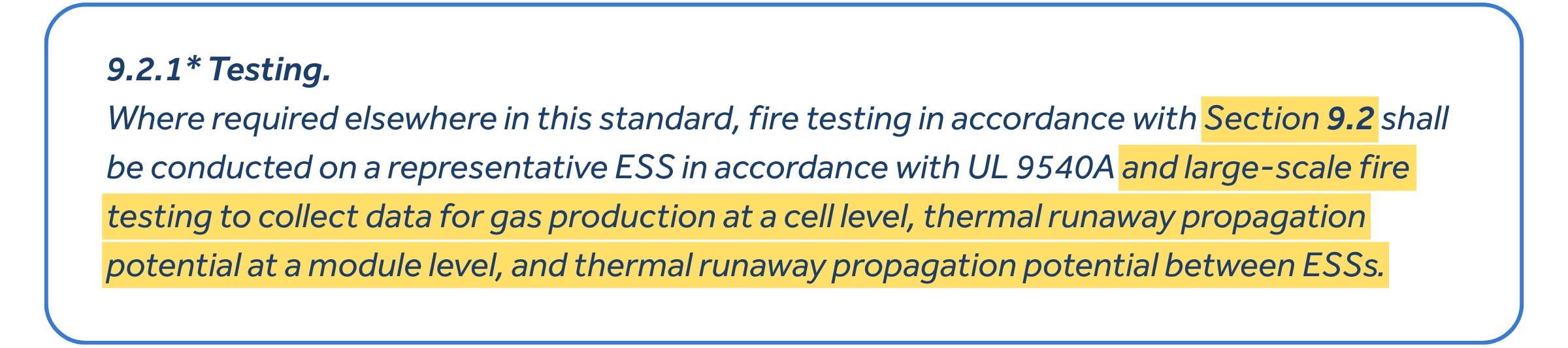
The highlighted text represents changes from the 2023 version of 855. As you see, the inclusion of “and large-scale fire testing” is a key addition to the requirement. This added text highlights the lack of ignition of flammable gases during the testing protocol before the sixth edition of UL9540A. In addition, a new section adds the requirement to ignite the flammable gases:
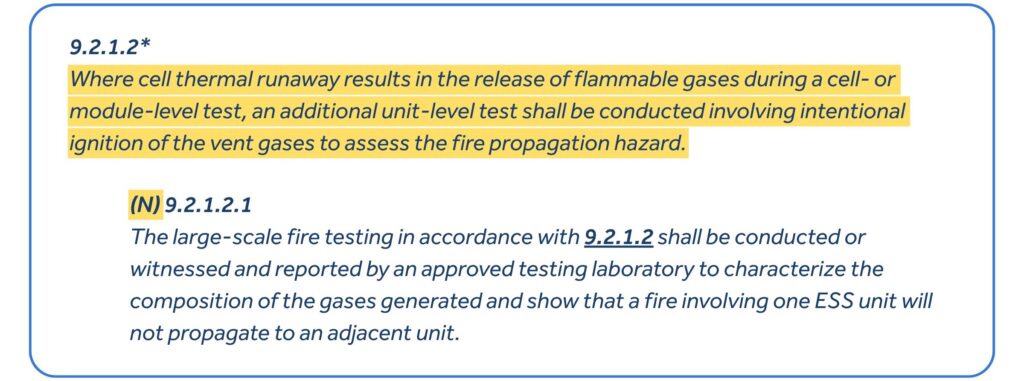
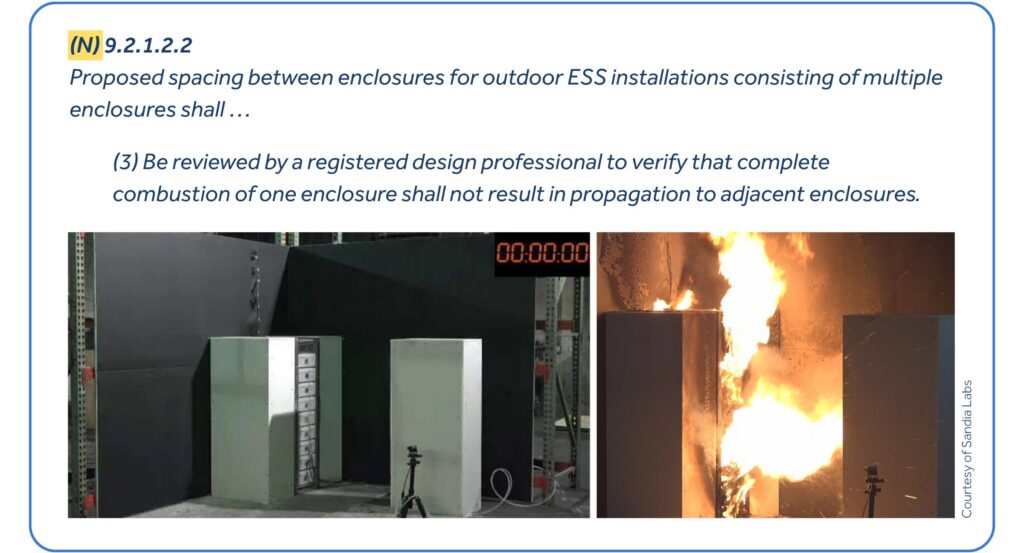
These changes will place the responsibility on ESS manufacturers to complete UL9540A testing and large-scale fire testing, and to provide the required reports to users and authorities having jurisdiction (AHJs). Undoubtedly, this places an extra burden on manufacturers to destroy functional BESS, but the resulting data and information will be valuable for individuals working with the equipment. Igniting the gases and documenting the results should lead more AHJs to approve installations that deviate from the standard unit-sizing and spacing language.
Hazard Mitigation Analysis
The second notable change revolves around the requirements for a hazard mitigation analysis (HMA). In the 2023 855, section 4.4.1 defined the conditions for when an HMA was required. The list consisted of six different scenarios with multiple references to Chapter 9 of 855. In 2026, the language has changed to require an HMA unless modified by Chapters 9-17.

For electrochemical storage systems, like lithium-ion batteries, the pertinent section in 2026 is 9.3.2 HMA for Electrochemical ESSs. This is a new numbering scheme from 2023. Still, the bigger difference is the elimination to the table used to determine an energy storage capacity value that would trigger the need for an HMA. In 2023, Table 9.4.1 requires an HMA for installations greater than 600kWh. Now, under 2026, the changes to 4.4.1 and the elimination of the table in Chapter 9 mean HMAs may be required for systems of all sizes above 20 kWh as required by the AHJ.
It is worth noting that the 2023 version has an option in 4.4.1 for AHJs to require an HMA “to address a potential hazard with an ESS installation that is not addressed by existing requirements.” 4.4.1 is an open-ended requirement that allows AHJs to require an HMA for a system of any size if all hazards aren’t addressed, similar to the 2026 language.
Emergency Response Planning and Training
Emergency response plans (ERPs) are a direct result of the HMAs. An HMA is written by and for fire protection engineers to understand and document the risk associated with a specific installation. ERPs provide digestible, site- and system-specific documentation to operators, owners, maintenance technicians, and first responders to develop procedures and train their teams.
In 2026, section 4.3 Emergency Planning and Training included several updates to help users of the standard understand proper ERP protocols and training requirements. The charging language for this section states:

The section goes on to describe the requirements for both the plans and training, separating them into two areas: facility staff and emergency response. The requirements fall on the system owner or their authorized representative. These plans are required to be developed in coordination with the AHJ and submitted to the AHJ before training. In addition, the ERP training shall occur prior to the ESS arriving on-site per 4.3.3.3.1, with annual refreshers for operations personnel.
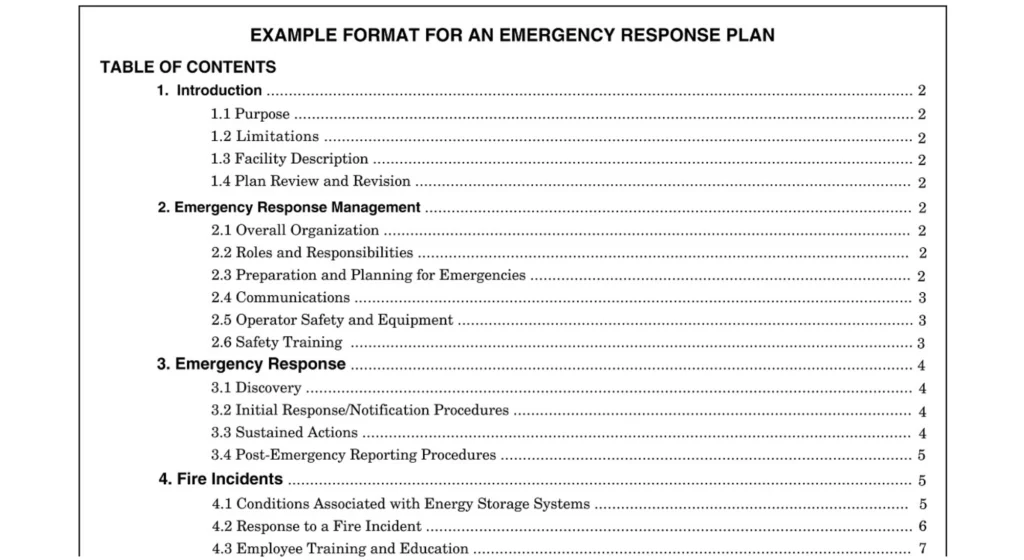
The NFPA 855 text defines these requirements, but it provides little direction or specific content. This is where the content of the informational annexes comes to the rescue. In 2026, Figure G.10.9 in Annex G provides a multi-page example of an ERP. If you need a good start on an ERP, this information will provide you with a solid foundation for creating one you can submit to your AHJ.
Conclusion
The changes presented here are not all-inclusive; we merely picked the three that rose to the top in terms of impact to the systems we are discussing with our clients and industry professionals in the commercial and industrial market. We encourage you to evaluate the new document and familiarize yourself with the requirements and changes.
Mayfield Renewables is an engineering consultancy specializing in commercial and industrial PV and microgrid engineering. Contact us today for a consultation.
Interested in learning more through Mayfield Renewables technical education? Check out our individual workshops on codes and standards on our website.


