

Technical Article
Hazard Mitigation Analyses: What Developers Need to Know
A proper Hazard Mitigation Analysis (HMA), if required for your project, will demand that any developer dedicate some time, resources, and attention during a project’s upfront planning. While the code language for a Hazard Mitigation Analysis (HMA) was first introduced in 2018, it’s gaining more attention in the commercial and industrial energy market segment this year. What do you need to know? Are HMAs in play for your next project? What functions do HMAs serve for system owners and other stakeholders?
The value of an HMA shows up through various moments of a BESS or PV + BESS project’s lifespan. When considered in the context of the project’s development, knowing your storage system is going to need an extra layer of de-risking with an HMA can bring into focus several decisions and action items—from BESS vendor selection to permitting, procurement, as well as commissioning and staff training phases.
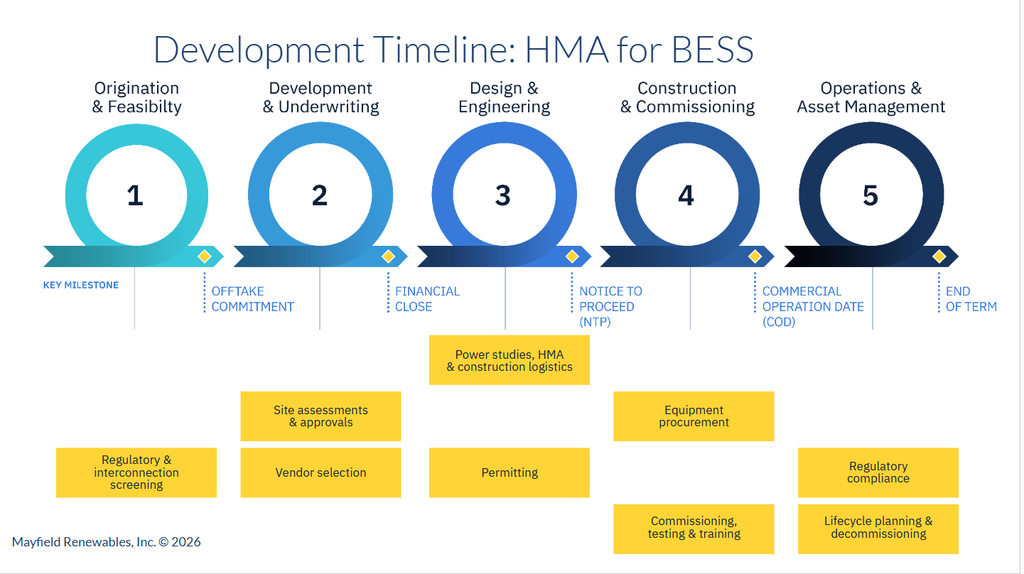
Explore this developmental framework, The Mayfield Standard further
Will my BESS project need an HMA?
An HMA? Yea or nay? There can be edge cases or extenuating circumstances, but for lithium-based BESS, it largely comes down to two questions: which fire code cycle is in play & what the project’s BESS nameplate reads.
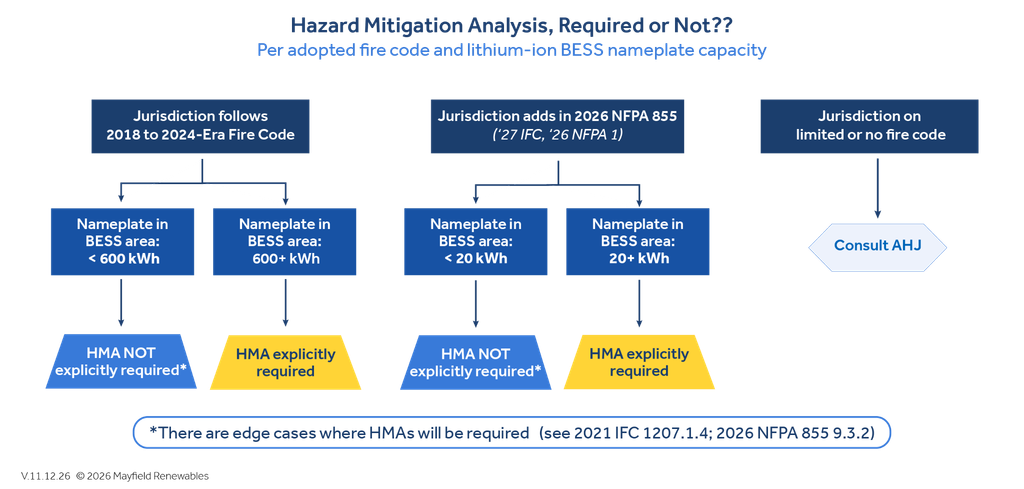
Rule of thumb: check your jurisdictional fire code and check your BESS nameplate
The best way to verify your fire code and/or installation standard year-edition is to consult the Authority-Having-Jurisdiction (AHJ). But there are some quick online resources that will get you started. The International Code Council (ICC) posts state-by-state summaries, and there are some third-party maps for reference.
The ICC and the National Fire Protection Association (NFPA) began providing guidance for BESS in 2018. For all but the recent round of documents, systems at 600 kWh or more per area require HMAs, and systems less than 600 kWh do not. ICC names this threshold “Maximum Allowable Quantities” within fire code; NFPA calls it “Maximum Stored Energy.” The newest round of this document pair removes this threshold, such that all systems within the scope of the 2026 NFPA 855, and 2027 IFC are required to execute an HMA — storage systems 20kWh and greater.
In either the 2018-era or 2026-era documents, a few edge cases may arise that require further consultation with a trusted industry partner. HMA exemptions based on chemistry are limited (lead-acid and aqueous nickel-based ESS). A couple of clauses exist that increase the likelihood of HMA requirements (unlisted BESS and cases of storage systems with differing technology types within the same BESS area).
Hazard Mitigation Analysis: What and Why
An HMA uses data from battery safety testing to identify hazards associated with an unlikely failure. Akin to a failure modes and effects analysis (FMEA), you can think of the HMA as assessing hazards and mitigation tactics, especially with regard to a potential fire or explosion. In some, but not all, BESS installations, this highly technical document is submitted to an AHJ and will be authored by those who know best: fire protection engineers. Strictly speaking, the HMA is one document, but its development is executed in steps and often done at the request, first by the BESS OEM at the product level, and then again by the developer, EPC, or site owner at the site level. Let’s break it down.
A product-level HMA answers the question: what happens if the electrical system were to fail with this particular BESS product involved, and what are the hazards? Are there mitigating measures to document? The inputs for this portion of the analysis include data included in the safety testing required for listing a BESS (UL 9540A, LSFT, NFPA 68, NFPA 69). More and more, reputable manufacturers are able to supply this portion of an HMA for their BESS product on request before or during procurement.
A site-level HMA continues the query by answering a similar question: if the electrical system were to fail, with this particular BESS product involved, at this particular site with this discrete equipment spacing and system layout, what happens, and what are the hazards? Are there mitigating measures to document?
An HMA does not directly aid the important work done by electrical system operators, O&M folks, or first responders. An HMA is vital to writing the documents and procedures that do aid these jobs — emergency operations plans, emergency response plans, commissioning and decommissioning plans.
Simply put, the reasons an HMA may be included in your project include:
- The project’s jurisdictional code/AHJ requires it
- It’s part of industry best practice for derisking lithium BESS,
- It’s one of the best uses of the product’s safety test data to prepare the BESS system operators, maintenance professionals, and first responders customized to a specific product at a specific installation site.
Additional Guidance: NFPA 855’s rising importance & ERP requirements
As more local jurisdictions segue into a fire code based on the 2027 IFC, you’ll notice the fire code is incorporating the 2026 NFPA 855 Standard for the Installation of Stationary Energy Storage Systems in many important sections. For example, the new 2027 IFC, Section 1207.4 simply sends us to the 2026 NPFA 855.
2027 IFC 1207.4 Fire safety and evacuation plan. A fire and evacuation plan complying with NFPA 855… shall be provided for review and approval.
So, 2026 NFPA 855 compliance is legally required for ESS installed per 2027 IFC. Diving one layer deeper here, fire safety and evacuation planning reveals another requirement EPCs and developers need to keep in view: the emergency response plan (ERP).
2026 NFPA 855 4.3 Emergency Planning and Training
4.3.1* General. ESS emergency planning and training shall be provided by the ESS owner or their authorized representative. …
4.3.3.2.2 The emergency response plan shall, at a minimum, address the following:
- 1. Mitigation
- 2. Preparedness
- 3. Response
- 4. Recovery
If this language sounds familiar to the HMA, it’s because it is. However, the audience and intent has shifted. Whereas an HMA uses fire testing data and the details of system design and site to create a technical document intended for AHJs and fire protection engineers; the ERP is intended for fire service and first response teams. (see 4.3.3 Emergency Response Plan and Training for more details).
If the HMA requirements feel new and your workflow depends on consultation with a trusted industry partner, know that Mayfield Renewables, Inc.’s consulting engineering services include HMA development. Contact us today for a consultation.