

Technical Article
Securing Capital: Framing Your System for Financiers in the Mid-Market
Commercial and industrial energy projects account for the largest share of the addressable market for distributed energy resources (DERs), yet they remain among the most difficult segments to finance. CleanSource Capital, the specialty finance affiliate of the Abundant Power Group based in Charlotte, North Carolina, has spent over a decade financing environmental sustainability projects, including renewable energy, alternative fuels, distributed generation, microgrids, and energy efficiency. Through its broker-dealer, CleanSource Securities, the firm arranges and places capital for projects in the smaller mid-market, where it sees the greatest potential for scale.
Greg Montgomery of CleanSource Capital likens the market to a pyramid. The bulk of the opportunity lies at the base, among smaller commercial and industrial properties, but those projects are harder to finance because capital providers require aggregated volume before a portfolio reaches meaningful scale. Developers who understand how financiers evaluate risk are better positioned to move their projects through underwriting and on to financial close.
The Challenge of Financing Smaller Commercial Projects
The commercial and industrial market is underserved from a financing standpoint, largely because smaller projects rarely share a standard use case. Each facility has its own requirements for distributed energy resources and how those resources will be used, which means every project brings a different set of variables for lenders to evaluate. Those differences make it harder to aggregate projects into portfolios large enough to attract institutional capital.
Closing that gap requires more than financial expertise alone. Financing partners who understand the technologies, applications, design, and engineering behind each system can work with developers and end users to structure projects that are both bankable and repeatable. When development, deployment, and operations are evaluated together, projects become easier to finance and deploy at scale.
How do financiers measure project complexity?
Project complexity is largely a function of how many components a system includes and how many use cases it is expected to serve. The general rule is that the more complicated a project is, the more difficult it will be to underwrite and finance. Projects with multiple use cases can still secure funding, but they face greater scrutiny than projects with simpler components and a single, straightforward use case.
For example, a project that combines energy generation and energy storage requires more interdependent parts, more intricate controls, communications, and sequence of operations than either a standalone PV system or a standalone battery energy storage system (BESS). Moreover, a multi-asset project presents the opportunity for multiple functions, and/or revenue streams. Each of these use cases adds a layer of complexity that must be modeled, verified, and underwritten. The Mayfield Standard breaks down complexity along these same lines, closely reflecting how lenders view risk.
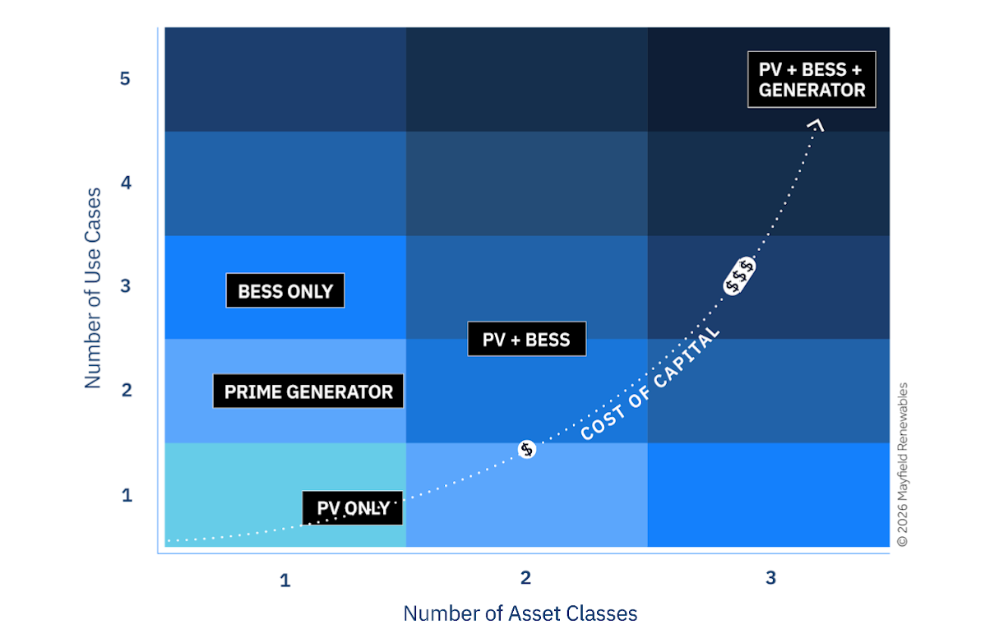
Developers who keep early projects as straightforward as possible give financiers fewer variables to evaluate and a clearer path to approval.
Microgrids as a New Asset Class
Microgrids combine energy generation, storage, and controls into a single integrated system. Each of those components is already a recognized asset class on its own, and many financial institutions are comfortable underwriting standalone solar, standalone battery storage, or standalone controls. Once those components are combined, however, the system depends on each piece communicating and operating with the others, and that interoperability creates a new asset class that lenders must evaluate from the ground up.
Many institutions have not yet built comfort with that combination, which makes the path to financing more demanding for microgrid developers. Lender confidence will grow as these systems establish a track record of performance over time. Until that history exists, Montgomery notes that simpler designs give projects the strongest chance of securing capital.
Where Financiers Focus Across the Project Lifecycle
The Mayfield Standard outlines five phases that carry a project from origination through long-term operation. A financing party will review all five because each phase supports the others, and weaknesses in construction, commissioning, or operations can affect the long-term viability of the investment. Even so, the first two phases carry the most weight from a financing standpoint.

Origination and conception are where many of the fundamental decisions are made, and those decisions shape everything that follows. Offtake is a particularly important milestone in this stage, since the offtake agreement establishes the revenue that will support the capital structure. Development, underwriting, and financial close follow closely behind, and Montgomery describes this as the point where a financier is most directly involved in getting the project to close with a capital structure that works.
Why Controls Design Affects Project Revenue
One of the most common mistakes in early project development is failing to confirm that the system can achieve its proposed use cases with a high degree of confidence. That confidence depends heavily on controls, including who designs them and who has final authority over the hierarchy that determines how the system operates. Montgomery identifies the control hierarchy as one of the most important decisions to settle during development, underwriting, feasibility, and design.
Projects that move forward without a clearly defined control strategy often encounter confusion and operational risk once the system is in service. If the equipment does not operate together as intended, the project may fail to deliver the energy it is contracted to provide, creating problems with the offtaker. In other cases, the system may generate energy but may still fall short of expected revenue, leaving less cash available to cover operating expenses and deliver returns to investors.
What role does an independent engineer play?
Because lenders are still gaining familiarity with integrated systems such as microgrids, they need assurance that a project will perform as designed before committing capital. An independent engineer provides that assurance by reviewing the design and confirming that the components, as specified and installed, can be expected to operate as safely and as intended. That third-party validation helps align a developer's system projections and a lender's need for objective evidence.
Independent review becomes especially valuable when a project combines multiple technologies or serves multiple use cases. Montgomery notes that financial parties will grow more comfortable with these systems as they build a track record of performance, and independent engineering plays a central role in getting the first projects across the finish line. Until that history is established, an independent engineer's evaluation gives financiers the confidence they seek to move forward with a project.
Standardization as a Tool to Reduce Risk
Smaller commercial and industrial projects are inherently variable, since each facility has its own energy needs and use cases. Standardizing as much of the design, engineering, and contractual work as possible reduces the number of variables a lender has to evaluate, and fewer variables mean less risk. The Mayfield Standard was built around that principle, creating uniformity that makes each project easier to understand and underwrite.
The Mayfield Standard provides developers and owners with a clear roadmap and shows how design, engineering, operations, and maintenance teams need to work together under a common approach. That coordination improves the likelihood of successful outcomes through construction, commissioning, and long-term operation. A project built on a standardized framework is easier to present to financiers and more likely to perform as expected once it is in service.
Conclusion
Financing commercial and industrial projects depends on how clearly a developer can show that a system will perform as intended and generate the revenue it promises. Keeping system designs as simple and practical to the system’s intended use, securing a well-defined offtake agreement, settling the control hierarchy early, and bringing in an independent engineer all give lenders greater confidence in a project's long-term viability. Decisions made during origination and development carry the most weight, so the effort invested in those early phases pays off throughout the project's life.
Standardization ties these practices together by reducing variables that increase risk and creating a shared approach among all involved in the project. As integrated systems like microgrids build a track record of performance, financiers will grow more comfortable with this emerging asset class. Developers who frame their projects around simplicity, clarity, and standardized practices today will be best positioned to secure the capital needed to bring them to completion.
To learn more about CleanSource Capital services, click here.
Download a copy of the Mayfield Standard white paper, which outlines our vision for the Standard and explains the five phases and milestones that are universal across different project types. Mayfield Renewables provides engineering, feasibility, and training services that help developers navigate the full project journey, from feasibility through end of life. Reach out to discuss where your project stands and what comes next.