

Technical Article
UL 9540A 5th Edition Anticipated Changes
Introduction and Context within the Commercial and Industrial Market
As new technologies and renewable energy solutions emerge on the market, the task of derisking them falls to a cadre of stakeholders. Recent failures involving stationary, lithium-based battery energy storage systems (BESS) are devastating in many ways, but they also offer valuable feedback and motivation to the code and standards-making bodies and the testing labs tasked with derisking these systems.
Since its publication in November 2019, the 4th edition of UL 9540A, The Standard for Safety for Test Method for Evaluating Thermal Runaway Fire Propagation in Battery Energy Storage Systems, has guided the 9540A tests performed on BESS products that carry the UL 9540 listing. Remember that, in order for a BESS product to receive the system-level UL 9540 qualification standard listing, the battery cell, module, and unit need to undergo the UL 9540A test method.

The product under test undergoes up to four levels of testing, spelled out in Sections 7 through 10. For a refresher on the 4th edition of UL 9540A, its four test levels to characterize thermal runaway and the test criteria, check out Mayfield Renewable’s technical article.
When any design or installation of a BESS exceeds the limits of spacing, separation, or maximum allowable kWh per fire area, it is UL 9540 A testing and data that can inform and make or break permitting prior to construction. The 5th edition was released in the spring of 2025, amid some ambiguous interpretations of key sections of the fire codes and standards for best BESS installation practices, such as the 2024 International Fire Code and 2023 NFPA 855. In short, a growing number of stakeholders in several jurisdictions are requesting that the testing methods assess a product’s fire and explosion risk factors in the presence of an open-flame ignition source, i.e. a ‘large-scale-fire-test.’ No edition of UL 9540A has yet required intentional ignition or provided procedural instructions for intentional ignition.
When to Expect Published Changes
To address this gap, the individuals tasked with revising the language of the 5th Edition are nearing the end of the necessary administrative steps to finalize a proposal.
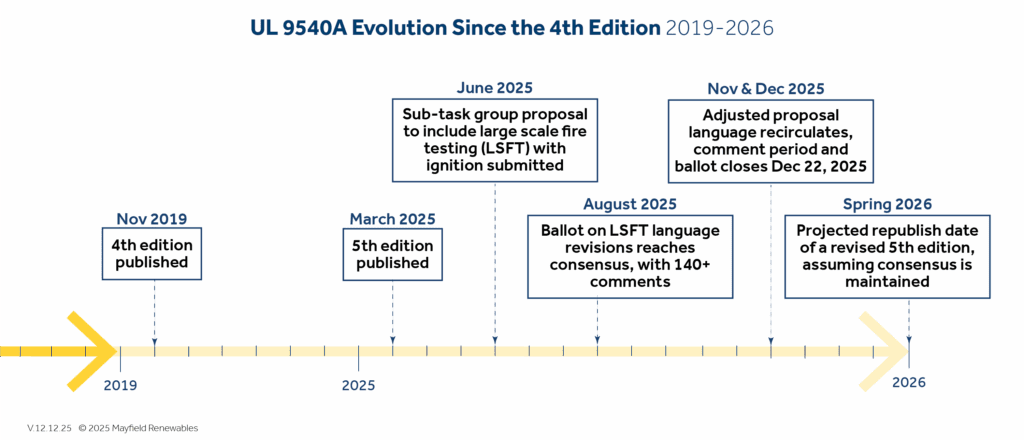
The “Revision of the Installation Level Testing to update requirements for large scale fire testing” proposal reached a consensus vote in August, and the UL sub-task group spent much of the fall addressing 140+ comments. The proposal is likely to maintain this consensus after balloting on December 22, 2025, with an anticipated re-release date of March or April, provided the consensus is maintained. How did we get here?
The Changes
The major revision pending is that the last UL 9540A test level will be a proper large scale fire test with ignition. Like previous editions, the original fifth edition from the spring of 2025 provides the last of the four levels in Section 10. In practice to date, few BESS products have gone past the third level of UL9540A testing into the installation-level. It is not surprising that the task group has revised Section 10, rather than, say, tack on a new, fifth level. For comparison’s sake:
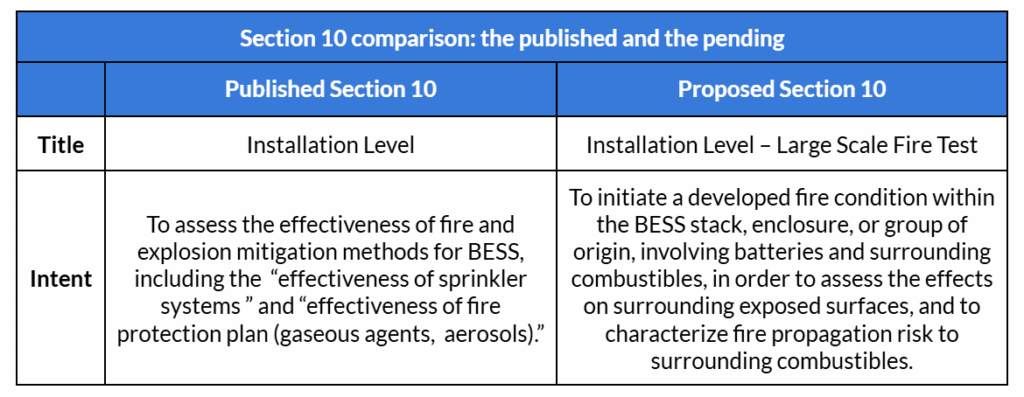
What was once a check on installation, with mitigation methods as per OEM instructions, is now an evaluation of the failure mode that fire officials, AHJs, and community representatives have been most interested in: thermal runaway with intentional ignition. The list of pending revisions is long and gets into the weeds quickly. While the proposal recirculates to the committee members, we’ll leave you with a couple of possibilities, knowing that consensus and re-release are not guaranteed.
Should the proposal pass, the large scale fire test in a new Section 10 would characterize BESS products for thermal runaway with all designed insulation materials in place. UL 9540A testing thus far has missed the mark a bit (according to some) here.
Should the proposal pass, manufacturers will be enabled to test multiple storage capacity configurations for similar product offerings, per a new Section 10. The cost of UL 9540A testing is not inconsequential, and it is the BESS manufacturers who fund the tests and provide material to burn. To test several SKU’s of BESS products with similar cathode chemistry, design, etc, an OEM will be able to test only the BESS configuration with the highest stored energy capacity (kWh). This large scale fire test evaluation would represent a test of all related systems of differing capacities (kWh), so long as the properties and geometries of all other components and materials are equivalent, by construction review.
One Other Caveat: Another ANSI-Recognized Large Scale Fire Test
There is at least one other ANSI-consensus large scale fire test published. CSA/ANSI C800-2025, “Testing protocol for energy storage system reliability and quality assurance program,” was developed in 2024 and published in February 2024. While C800:2025 is consistent with Annex G of NFPA 855, the annexes are instructional and not ‘normative.’ C800:2025 is yet to receive similar explicit mention in Chapter 12 of the IFC or Chapter 9 of NFPA 855.
Mayfield Renewables is an engineering consultancy specializing in commercial and industrial PV and microgrid engineering. Contact us today for a consultation.

