
Technical Article
The 6th Edition of UL 9540A is Here
What & When
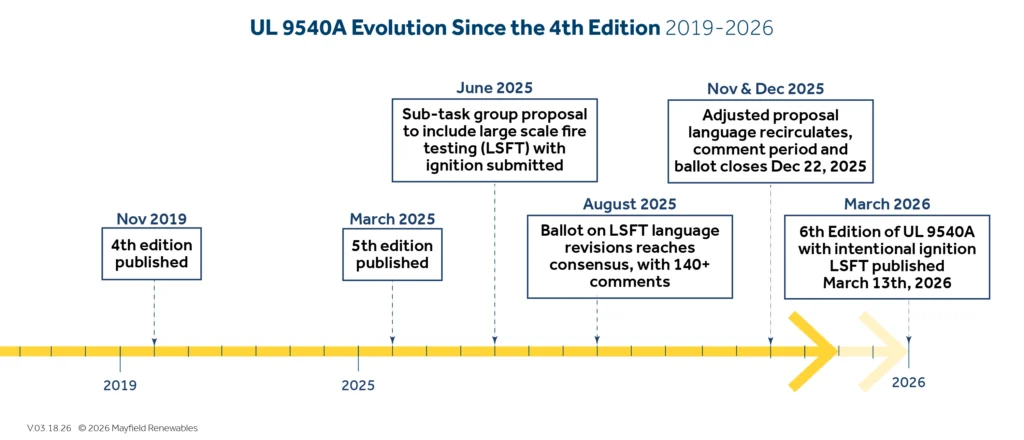
Despite retaining the title, “Standard Method for Evaluating Thermal Runaway Fire Propagation in Battery Energy Storage Systems,” UL 9540A has gotten a makeover. In its sixth edition, this performance standard spells out the testing protocols for a more expansive evaluation of the failure mode that fire officials, AHJs, and community representatives have been most interested in lately: thermal runaway with intentional ignition of the resultant off-gasses.
The technical committee responsible for navigating the revisions, comment periods, and balloting wrapped up in February. The 6th edition was published and available on March 13th, 2026.
Why This Update to UL 9540A is Important
Within the commercial and industrial markets, this is welcomed news for at least three reasons.
First, installing a "listed" battery energy storage system (ESS) is required by Code – namely, UL 9540 for stationary ESS. To achieve system-level certification to UL 9540 means that the system's batteries must also meet the performance criteria of the performance standard UL 9540A. In a nutshell, the batteries in a given battery energy storage system that seeks UL 9540 listing must get tested to UL 9540A. The new edition of UL 9540A helps characterize, in a controlled laboratory setting, the fire and explosion risks of any battery product in at least two failure modes: thermal runaway and off-gassing in the presence of an ignition source.
The new edition of UL 9540A helps characterize, in a controlled laboratory setting, the fire and explosion risks of any battery product in at least two failure modes: thermal runaway and off-gassing in the presence of an ignition source.
Second, we need both of the assessments noted above in order to better de-risk our ESS products and projects. Previous editions of UL 9540A only included an assessment of thermal runaway characteristics, not the intentional ignition that many first responders and AHJs were looking for.
Given how intertwined codes and standards are, it shouldn't be surprising that UL 9540A isn’t the only important document getting a refresh: the 2026 edition of NFPA 855, Standard for the Installation of Stationary Energy Storage Systems makes this exact two-part characterization of fire and explosion risk a requirement for both thermal runaway and large scale fire testing. Take 2026 NFPA 855, Section 9.2.1:
9.2.1* Testing. Where required elsewhere in this standard, fire testing in accordance with Section 9.2 shall be conducted on a representative ESS in accordance with UL 9540A and large-scale fire testing to collect data for gas production at a cell level, thermal runaway propagation potential at a module level, and thermal runaway propagation potential between ESSs.
9.2.1.2* Where cell thermal runaway results in the release of flammable gases during a cell- or module-level test, an additional unit-level test shall be conducted involving intentional ignition of the vent gases to assess the fire propagation hazard.
If your local AHJ(s) adopt NFPA 855 as their model fire code, these updated requirements are coming your way soon. Manufacturers should be prepared to support additional product testing as part of the UL 9540 listing process, and developers should be prepared to request additional test data that characterizes an ESS's behavior in both conditions: thermal runaway and large-scale fire testing with intentional ignition.
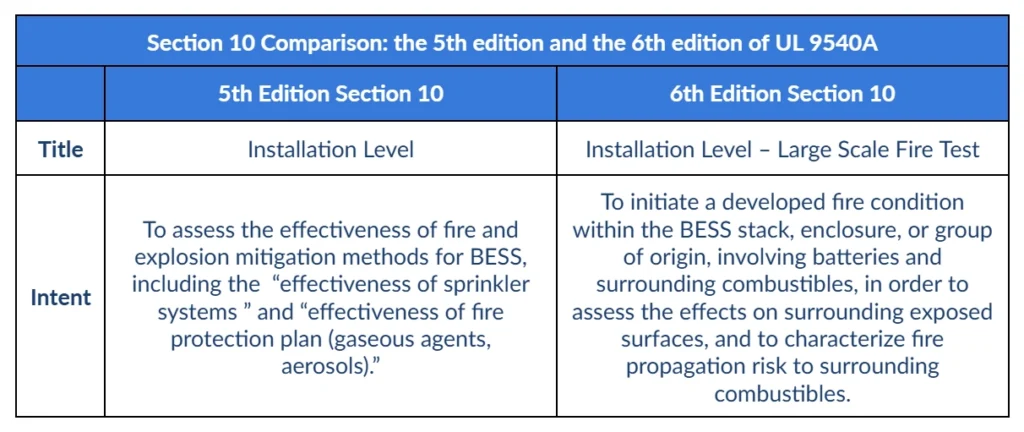
One of the industry's most pressing questions over the last few years has been, “Is UL 9540A truly a large-scale fire test?” The answer seemed frustratingly varied by time-stamp and jurisdiction. Now, the answer is (or ought to be) a resounding "yes." With the 6th edition of UL 9540A, the large-scale fire test is fully integrated as the 4th level of the ESS evaluation following the cell-, module-, and unit-level tests. This new 4th level replaces what was previously called the "installation-level" test, which primarily assessed the effectiveness of sprinkler and aerosol systems in ESS units that had already achieved thermal runaway. Now, the 4th level includes intentional ignition of off-gases to assess whether a fire or explosion occurs, and its impacts on its surroundings.
Third, many BESS designers, owners, and operators rely on more complete fire testing. Pairing thermal runaway testing with intentional ignition testing can empower certain compliance pathways and fire code exceptions. For example, empirical test data from the 6th edition of 9540A could be used to increase the maximum allowable quantity (in kWh) per fire area, or to reduce inter-unit spacing requirements or distances from other exposures. UL 9540A data can justify, inform, and ultimately make or break whether an ESS project is approved.
With the 6th edition of UL 9540A, there’s reason to be optimistic that permitting and commissioning processes will come with less confusion around fire and explosion testing.
Mayfield Renewables is an engineering consultancy specializing in commercial and industrial PV and microgrid engineering. Contact us today for a consultation.
Interested in learning more through Mayfield Renewables technical education? Check out our individual workshops on codes and standards on our website!

